
AWS Shatters Records: AI Revenue Blows Past $15 Billion Run Rate

AWS and AI: an unprecedented money-printing machine
Amazon Web Services just dropped a number that has sent shockwaves through the entire tech industry: its artificial intelligence business now generates over $15 billion in annualized revenue. The figure, revealed in Q1 2026 earnings, confirms what many suspected but few dared to state outright: massive hyperscaler investments in AI infrastructure are producing real, quantifiable returns.

Fuente: Unsplash
And that is not all. Amazon's custom chip business — which includes Graviton processors for general compute and Trainium chips for AI model training — has reached an annual revenue run rate exceeding $20 billion, roughly double the figure cited earlier this year.
Where is all this revenue coming from?
AWS's AI business is not a single product — it is a full-stack ecosystem spanning multiple layers of the value chain:
- Amazon Bedrock — A foundation model platform that lets enterprises access models from Anthropic (Claude), Meta (Llama), Mistral, and Amazon Titan without managing infrastructure
- Amazon SageMaker — Enterprise-grade machine learning training and deployment service
- EC2 instances with GPUs and Trainium — AI-optimized compute infrastructure, including Amazon's proprietary chips
- Amazon Q — Generative AI assistant for enterprises, integrated with AWS services and corporate data
- AWS Inferentia — Purpose-built chips for low-cost model inference
The custom chip wars: Graviton and Trainium
Perhaps the most jaw-dropping story buried in these results is the explosive growth of Amazon's custom chip business. With a run rate now exceeding $20 billion, Amazon has accomplished something few thought possible: competing directly with Nvidia in AI hardware.
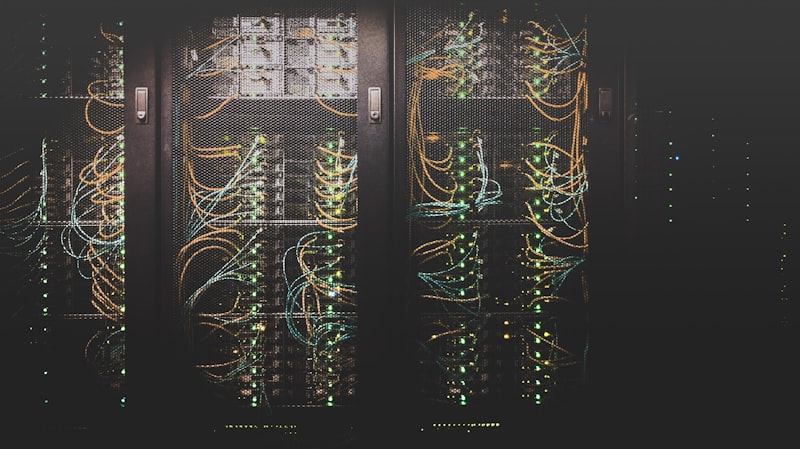
Fuente: Unsplash
The Trainium 2 chips, launched in late 2025, deliver training performance up to 4x better than the previous generation, at a significantly lower cost per token compared to Nvidia GPUs. This has attracted customers like Anthropic, which uses Trainium to train its Claude models, and dozens of AI startups looking to slash their infrastructure costs.
AWS vs Azure vs Google Cloud: the battle for cloud AI
The race to lead the cloud AI market has turned into a fierce competition among the three major hyperscalers. Here are the latest numbers:
| Metric | AWS (Amazon) | Azure (Microsoft) | Google Cloud |
|---|---|---|---|
| Total cloud revenue (Q1 2026) | ~$29B | ~$26B | ~$12.5B |
| AI run rate | $15B | ~$13B (est.) | ~$8B (est.) |
| Custom AI chips | Trainium, Inferentia | Maia 100 | TPU v5p, Axion |
| Custom chip run rate | $20B | Not disclosed | Not disclosed |
| Proprietary foundation models | Amazon Titan | Phi, MAI | Gemini |
| Primary AI partner | Anthropic | OpenAI | DeepMind (internal) |
| YoY growth | ~22% | ~33% | ~28% |
What does this mean for the industry?
AWS's results carry profound implications for the entire technology sector:
1. AI investment IS paying off
For months, Wall Street questioned whether the hundreds of billions poured into AI infrastructure would ever generate returns. AWS's numbers answer with a resounding "yes". A business that grows from zero to $15 billion in under three years is not a bubble — it is a revolution.
2. The era of Nvidia dependency is weakening
With $20 billion in annualized custom chip revenue, Amazon proves it is possible to build viable alternatives to Nvidia GPUs. This pressures Nvidia to keep prices competitive and accelerate its innovation pace, which benefits the entire industry.
3. Enterprises are adopting AI faster than expected
The growth of AWS's AI run rate implies that thousands of companies are migrating AI workloads to the cloud at an unprecedented pace. This is not just experimentation: these are production deployments generating real business value.
What comes next?
Amazon has no intention of slowing down. Plans for the rest of 2026 include:
- Trainium 3 — The next-generation training chip, expected in late 2026, promises another 3x jump in performance
- Bedrock 2.0 — An upgraded foundation model platform with native support for autonomous AI agents
- Data center expansion — Amazon has committed over $100 billion in CapEx for 2026, with the majority earmarked for AI infrastructure
- Amazon Q Enterprise — Expanding the AI assistant to integrate with SAP, Salesforce, and other enterprise systems
Sources and references
- Amazon Q1 2026 Earnings Release
- AWS Blog — AI Updates
- CNBC — Cloud Computing Coverage
- Reuters — Technology
If you are interested in expanding your programming skills to work with cloud data, check out our Python Course: Data Structures.
Comments
Sign in to leave a comment
No comments yet. Be the first!
Related Articles
May 3, 2026
GPT-5.5 and Codex in 2026: pros, cons, pricing and performance (no hype)
IA y Machine LearningMay 3, 2026
GPT-5.5 y Codex en 2026: ventajas, desventajas, precios y rendimiento (sin hype)
IA y Machine LearningApril 13, 2026
Why AI Is Making People Lazier in 2026: A Technical, Level-Headed Look
AIStay updated
Get notified when I publish new articles in English. No spam, unsubscribe anytime.