
3 Ways Companies Are Using AI to Be More Profitable in 2026

AI Is No Longer Optional — It's a Profit Engine
In 2026, artificial intelligence has moved far beyond the hype cycle. Companies that once viewed AI as experimental are now reporting measurable revenue increases and cost reductions directly tied to their AI investments. According to McKinsey's latest Global AI Survey, organizations that have fully adopted AI report a 25% average increase in EBIT (earnings before interest and taxes) attributable to AI use cases.
But here's the key insight: the companies seeing the biggest returns aren't chasing the flashiest AI applications. They're focusing on three proven strategies that deliver consistent, scalable profitability.

Source: Google DeepMind — Unsplash
1. Intelligent Process Automation (RPA + AI)

Source: Alex Knight — Unsplash
Traditional Robotic Process Automation (RPA) follows rigid, rule-based scripts. Add AI to the mix — natural language processing, computer vision, and decision-making models — and you get Intelligent Process Automation (IPA), which can handle unstructured data, make judgment calls, and adapt to exceptions.
How it works in practice
Consider an insurance company processing claims. Traditional RPA can extract data from a standardized form. But AI-powered automation can:
- Read handwritten notes and unstructured medical reports using OCR + NLP
- Cross-reference the claim against policy terms using LLM-based document analysis
- Flag potentially fraudulent claims using anomaly detection models
- Auto-approve straightforward claims and route complex ones to human adjusters
Real-world examples
JPMorgan Chase deployed an AI system called COiN (Contract Intelligence) that reviews commercial loan agreements. What previously required 360,000 hours of lawyer time per year now takes seconds. The system extracts 150 attributes from each document with higher accuracy than manual review.
Siemens uses AI-powered automation across its manufacturing plants for predictive maintenance. Sensors collect real-time data from equipment, and AI models predict failures before they happen. Result: 20% reduction in unplanned downtime and $50 million in annual savings.
UiPath + AI — the leading RPA platform now integrates LLMs directly into automation workflows:
1# Example: AI-enhanced document processing pipeline
2from uipath import Robot, AICenter
3
4robot = Robot()
5ai = AICenter(model="document-understanding-v3")
6
7# Extract data from unstructured invoices
8invoices = robot.get_queue_items("InvoiceQueue")
9
10for invoice in invoices:
11    # AI extracts fields from any invoice format
12    extracted = ai.predict(
13        document=invoice.file_path,
14        fields=["vendor_name", "total_amount", "due_date",
15                "line_items", "tax_amount"]
16    )
17
18    # Confidence-based routing
19    if extracted.confidence > 0.95:
20        robot.create_entry("AutoApproved", extracted.data)
21    else:
22        robot.create_entry("HumanReview", extracted.data)
The profitability impact
| Metric | Before IPA | After IPA | Improvement |
|---|---|---|---|
| Invoice processing time | 15 min/invoice | 45 sec/invoice | 95% faster |
| Error rate | 4-5% | 0.5% | 90% reduction |
| FTE required | 25 employees | 5 employees | 80% reduction |
| Annual cost savings | — | $2.1M | Direct savings |
2. AI-Powered Customer Experience Personalization

Source: Blake Wisz — Unsplash
Personalization is not new. What's new is the depth and speed at which AI can now personalize every touchpoint of the customer journey — from the first website visit to post-purchase support — in real time.
Beyond "customers who bought X also bought Y"
Modern AI personalization engines use multi-modal signals to build a dynamic customer profile:
- Behavioral data: clicks, scroll depth, time on page, search queries
- Contextual data: device, location, time of day, weather
- Transactional data: purchase history, cart abandonment patterns, lifetime value
- Sentiment data: support tickets, reviews, social media mentions analyzed by NLP
Real-world examples
Netflix saves an estimated $1 billion per year through its AI recommendation engine. Their system doesn't just recommend titles — it personalizes thumbnails, row order, and even the synopsis text shown to each user. The AI runs over 250 A/B tests simultaneously to optimize engagement.
Starbucks uses its Deep Brew AI platform to personalize offers for each of its 75 million rewards members. The system analyzes purchase history, local weather, time of day, and nearby store inventory to suggest the right drink at the right moment. Result: 3x increase in offer redemption rates and a measurable boost in average order value.
Spotify generates over 1.5 billion unique playlists per week using its AI engine. Their Discover Weekly feature alone has been credited with reducing churn by keeping users engaged with fresh, personally relevant content.
1// Example: Real-time personalization API with AI scoring
2interface CustomerSignal {
3  userId: string;
4  event: "page_view" | "add_to_cart" | "search" | "purchase";
5  metadata: Record<string, unknown>;
6  timestamp: Date;
7}
8
9interface PersonalizedResponse {
10  recommendations: Product[];
11  dynamicPricing: { discount: number; reason: string } | null;
12  nextBestAction: string;
13  contentVariant: "A" | "B" | "C";
14}
15
16async function personalizeExperience(
17  signal: CustomerSignal
18): Promise<PersonalizedResponse> {
19  // 1. Update real-time customer profile
20  const profile = await customerGraph.update(signal);
21
22  // 2. AI scoring: propensity to buy, churn risk, LTV prediction
23  const scores = await aiEngine.score(profile, {
24    models: ["purchase_propensity", "churn_risk", "ltv_prediction"],
25  });
26
27  // 3. Generate personalized recommendations
28  const recommendations = await aiEngine.recommend(profile, {
29    strategy: scores.churnRisk > 0.7 ? "retention" : "upsell",
30    limit: 8,
31  });
32
33  // 4. Dynamic pricing based on elasticity model
34  const dynamicPricing =
35    scores.purchasePropensity > 0.8
36      ? null // High intent — no discount needed
37      : { discount: 10, reason: "win-back" };
38
39  return { recommendations, dynamicPricing,
40    nextBestAction: scores.churnRisk > 0.7
41      ? "trigger_retention_email" : "show_upsell_banner",
42    contentVariant: profile.segment === "power_user" ? "C" : "A",
43  };
44}
The profitability impact
| Company | AI Personalization Strategy | Result |
|---|---|---|
| Amazon | Product recommendations | 35% of total revenue from AI suggestions |
| Netflix | Content personalization | $1B/year saved in reduced churn |
| Starbucks | Offer personalization | 3x redemption rate increase |
| Spotify | Music discovery | Measurable churn reduction |
| Sephora | Virtual try-on + recommendations | 11% increase in average order value |
3. Predictive Analytics for Strategic Decision-Making
Source: Luke Chesser — Unsplash
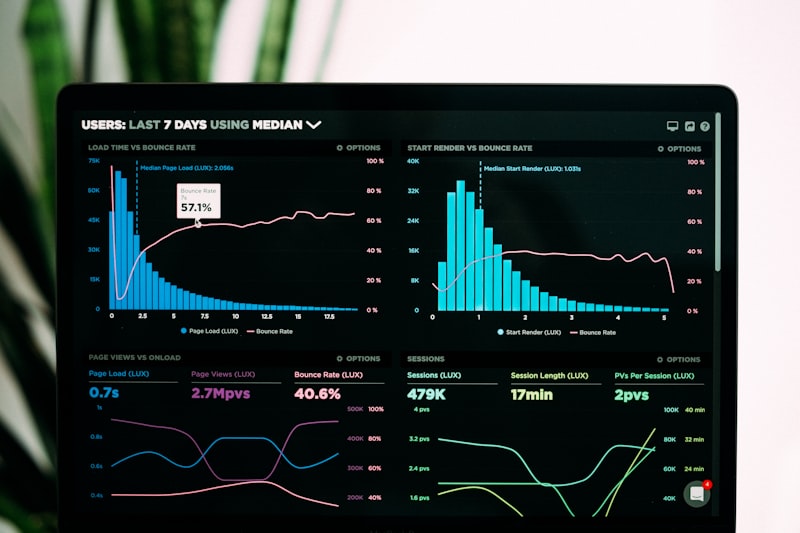
The third — and arguably most transformative — way companies use AI for profitability is predictive analytics: using historical data and machine learning to forecast what will happen next, and making better decisions because of it.
From reactive to predictive
Traditional business intelligence tells you what happened. Predictive analytics tells you what will happen and what you should do about it. The difference in business impact is enormous:
- Demand forecasting: predict exactly how much inventory to stock, reducing waste and stockouts
- Churn prediction: identify at-risk customers weeks before they leave, enabling proactive retention
- Dynamic pricing: adjust prices in real time based on demand, competition, and customer willingness to pay
- Risk assessment: evaluate credit risk, fraud probability, or supply chain disruptions before they happen
Real-world examples
Walmart uses AI-driven demand forecasting across its 10,500+ stores worldwide. Their system analyzes sales data, weather patterns, local events, social media trends, and economic indicators to predict demand at the individual SKU level. Result: $1.5 billion in annual savings from optimized inventory management and a 30% reduction in stockouts.
Uber uses predictive models to forecast rider demand in every zone of every city, minutes to hours in advance. This powers their surge pricing algorithm and driver positioning system. The result is shorter wait times for riders and higher earnings for drivers — a win-win that directly improves their unit economics.
Capital One was one of the first financial institutions to use machine learning for credit risk assessment at scale. Their models evaluate hundreds of variables beyond traditional credit scores, enabling them to approve more loans while maintaining lower default rates. This approach has been a key competitive advantage that helped them become one of the top 10 US banks.
1# Example: Churn prediction pipeline with scikit-learn
2import pandas as pd
3from sklearn.ensemble import GradientBoostingClassifier
4from sklearn.model_selection import train_test_split
5from sklearn.metrics import classification_report
6
7# Load customer behavior data
8df = pd.read_sql("""
9    SELECT c.customer_id, c.tenure_months, c.monthly_spend,
10           c.support_tickets_last_90d, c.login_frequency,
11           c.last_purchase_days_ago, c.nps_score,
12           CASE WHEN c.status = 'churned' THEN 1 ELSE 0 END as churned
13    FROM customer_360 c
14    WHERE c.signup_date < CURRENT_DATE - INTERVAL '6 months'
15""", connection)
16
17# Feature engineering
18features = ["tenure_months", "monthly_spend",
19            "support_tickets_last_90d", "login_frequency",
20            "last_purchase_days_ago", "nps_score"]
21
22X = df[features]
23y = df["churned"]
24
25X_train, X_test, y_train, y_test = train_test_split(
26    X, y, test_size=0.2, random_state=42, stratify=y
27)
28
29# Train churn prediction model
30model = GradientBoostingClassifier(
31    n_estimators=200, max_depth=5, learning_rate=0.1
32)
33model.fit(X_train, y_train)
34
35# Evaluate
36predictions = model.predict(X_test)
37print(classification_report(y_test, predictions))
38
39# Score active customers for proactive retention
40active = pd.read_sql(
41    "SELECT * FROM customer_360 WHERE status = 'active'",
42    connection
43)
44active["churn_probability"] = model.predict_proba(
45    active[features]
46)[:, 1]
47
48# Flag high-risk customers for retention campaigns
49high_risk = active[active["churn_probability"] > 0.7]
50print(f"High-risk customers: {len(high_risk)}")
51print(f"Potential revenue at risk: ${high_risk['monthly_spend'].sum() * 12:,.0f}/year")
The profitability impact
| Use Case | Industry | Typical ROI |
|---|---|---|
| Demand forecasting | Retail | 20-30% reduction in inventory costs |
| Churn prediction | SaaS / Telecom | 15-25% reduction in churn rate |
| Dynamic pricing | Travel / E-commerce | 5-15% revenue increase |
| Fraud detection | Financial Services | 50-70% reduction in fraud losses |
| Predictive maintenance | Manufacturing | 25-40% reduction in maintenance costs |
How to Get Started: A Practical Roadmap
If your company hasn't yet implemented AI for profitability, here's a proven step-by-step approach:
Phase 1: Identify high-value use cases (Weeks 1-4)
- Audit your processes: map where humans spend time on repetitive, rule-based tasks
- Calculate the cost of inaction: what are you losing to inefficiency, churn, or poor forecasting?
- Prioritize by ROI: start with the use case that has the highest impact and lowest implementation complexity
Phase 2: Build a proof of concept (Weeks 5-12)
- Start small: one process, one department, one prediction model
- Measure everything: establish baseline KPIs before AI and track improvements rigorously
- Use existing tools: don't build infrastructure — use cloud AI services and existing platforms
1# Example: AI initiative scoring matrix
2ai_use_cases:
3  - name: "Invoice processing automation"
4    impact: high        # $2M+ annual savings
5    complexity: low     # Off-the-shelf OCR + LLM
6    data_readiness: high # Structured invoices available
7    priority_score: 9.2
8
9  - name: "Customer churn prediction"
10    impact: high        # $5M+ revenue retention
11    complexity: medium  # Requires data pipeline
12    data_readiness: medium # CRM data needs cleaning
13    priority_score: 7.8
14
15  - name: "Dynamic pricing engine"
16    impact: very_high   # 10-15% revenue increase
17    complexity: high    # Requires real-time infrastructure
18    data_readiness: low # Competitor data hard to obtain
19    priority_score: 6.1
Phase 3: Scale what works (Months 4-12)
- Expand successful pilots to other departments or geographies
- Invest in data infrastructure: clean, unified data is the foundation of all AI success
- Build internal AI literacy: train your team to work alongside AI tools effectively
The Numbers Don't Lie: AI's Impact on the Bottom Line
Let's look at the aggregate data across industries:
| Statistic | Source | Year |
|---|---|---|
| Companies using AI report 25% higher EBIT on average | McKinsey Global AI Survey | 2025 |
| AI-driven personalization increases revenue by 10-30% | Boston Consulting Group | 2025 |
| Predictive maintenance reduces costs by 25-40% | Deloitte AI Institute | 2025 |
| AI automation delivers 3-10x ROI within first year | Forrester Research | 2026 |
| 80% of executives say AI has increased revenue | PwC Global AI Study | 2025 |
The pattern is clear: AI is not a cost center — it's a profit multiplier. Companies that treat AI as a strategic investment rather than a technology experiment are pulling ahead of their competitors at an accelerating rate.
Conclusion: The Three Pillars of AI Profitability
The three strategies we've covered — intelligent process automation, AI-powered personalization, and predictive analytics — are not theoretical possibilities. They are proven, battle-tested approaches being used right now by companies of all sizes to drive measurable profitability.
The best part? You don't need a massive budget or a team of PhDs to get started. With modern cloud AI services, open-source models, and no-code automation platforms, the barrier to entry has never been lower.
The question is no longer "Should we use AI?" — it's "Where should we use AI first?"
Start with one high-impact use case, prove the ROI, and scale from there. The companies that act now will have a compounding advantage over those that wait.
Comments
Sign in to leave a comment
No comments yet. Be the first!
Related Articles
May 3, 2026
GPT-5.5 and Codex in 2026: pros, cons, pricing and performance (no hype)
IA y Machine LearningMay 3, 2026
GPT-5.5 y Codex en 2026: ventajas, desventajas, precios y rendimiento (sin hype)
IA y Machine LearningApril 13, 2026
Why AI Is Making People Lazier in 2026: A Technical, Level-Headed Look
AIStay updated
Get notified when I publish new articles in English. No spam, unsubscribe anytime.